If you have ever shopped for a natural hide, you may have encountered descriptions such as “upholstery grade,” “decorative grade,” or “non-upholstery grade.” But what do those terms actually mean — and does a higher grade always mean a better hide?
Not necessarily.
A beautiful hide is not automatically an upholstery hide, and a hide that is not suited for upholstery is not necessarily a poor-quality hide. The important question is much simpler:
What do you intend to do with it?
A hide that will remain whole and be displayed decoratively has very different requirements from one that will be cut into panels for a chair, ottoman, bench, or pillow.
Understanding that distinction can help you choose a hide for its intended purpose rather than simply buying the most expensive grade available.
What Does “Upholstery Grade” Mean?
When a natural hide is described as upholstery grade, it generally means the hide has enough clean, usable area to make it suitable for cutting and incorporating into furniture, pillows, and other fabricated pieces.
For an upholsterer, the beauty of the entire hide is only part of the equation.
They also need usable sections.
A furniture maker may need to place a pattern for a chair back, cushion panel, ottoman top, or another component onto the hide. Repairs, holes, significant hair loss, or other interruptions in that particular section can reduce the amount of material available for the project.
That is why an upholstery-grade hide is valued not simply for how attractive it looks as a whole, but for how much usable material it provides within the areas that matter.
In practical terms, an upholstery-grade hide may offer:
- A cleaner central area
- Fewer repairs or patches within important cutting areas
- More uninterrupted material for fabrication
- Greater flexibility when positioning upholstery patterns
- Usable sections appropriate for pillows, chair panels, ottomans, benches, and other accents
The exact character of every natural hide will still vary. That is part of working with a genuine natural material.
What Is a Non-Upholstery-Grade Hide?
A non-upholstery-grade hide may contain patches, repairs, scars, holes, hair loss, or other characteristics that make portions of the hide less desirable for cutting into furniture components.
That does not automatically make it unattractive.
In fact, a non-upholstery hide can be every bit as visually striking when used in an application where the hide remains substantially intact.
The distinction is primarily about intended use and usable cutting area.
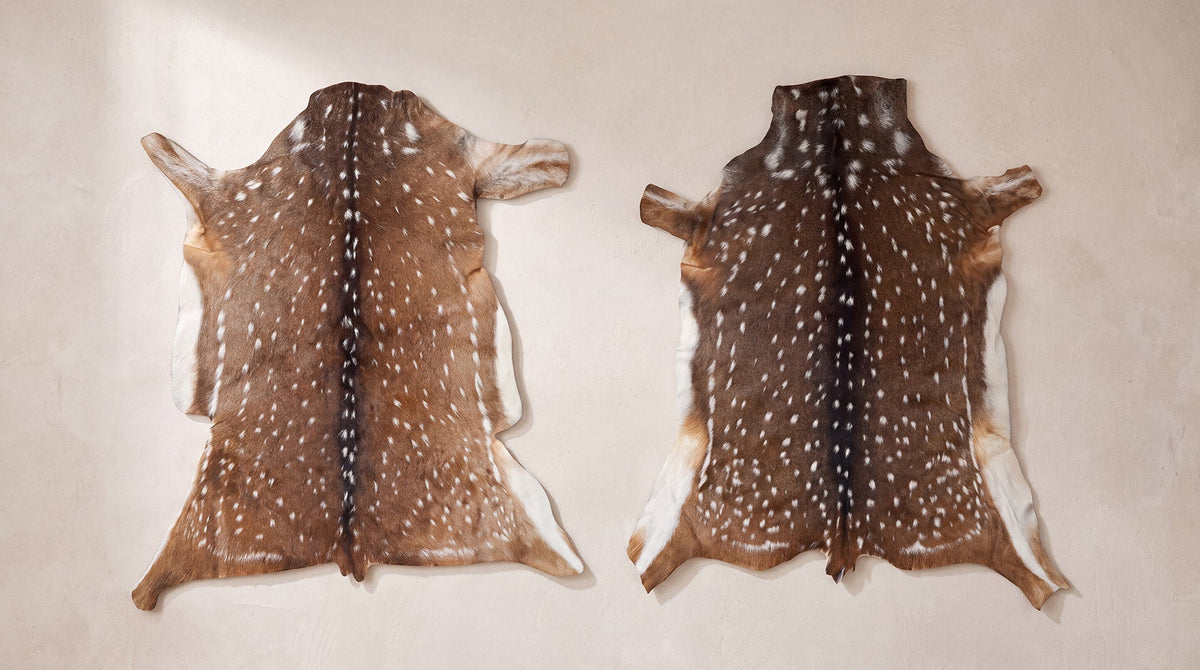
For example, some of our Axis Deer Hides are available in both upholstery and non-upholstery grades.
Our upholstery-grade Axis hides are selected to provide a cleaner usable area for projects such as pillows, furniture accents, and other fabricated applications.
Non-upholstery-grade Axis hides may contain patches along the spine or other areas. Depending on how the hide will be displayed or used, those characteristics may have little bearing on whether it is the right hide for the project.
In other words:
Non-upholstery grade does not mean “bad hide.”
It means a different type of hide for a different type of application.
Think About the Finished Project First
One of the easiest mistakes to make when shopping for natural hides is selecting the grade before deciding how the material will actually be used.
Start with the finished project instead.
If You Are Making a Pillow
A pillow requires a clean section large enough to accommodate the front panel.
The usable cutting area matters considerably because a repair, hole, or undesirable marking may fall directly where the pillow pattern needs to be placed.
This is an application where an upholstery-grade hide makes sense.
Our Axis Deer Pillows, for example, illustrate how the natural spotting of the hide can become the focal point of a finished decorative piece.
If You Are Upholstering a Chair
The situation becomes even more demanding.
An upholsterer must consider not only whether enough usable hide exists, but also where the pattern and coloration fall within each cut piece.
With a naturally patterned hide such as Axis deer, placement becomes part of the design.
A chair back centered over an attractive field of white spots will look very different from one cut from an edge or less visually distinctive section of the same hide.
For this reason, upholstery projects require both adequate usable material and thoughtful planning.
If You Are Covering an Ottoman or Bench
Large uninterrupted surfaces become particularly important.
An ottoman top or bench panel may require a relatively broad portion of the hide, making repairs and interruptions in the central area more consequential than they would be for a smaller project.
Before ordering a hide for a specific upholstery project, consider the dimensions of the piece and discuss the cutting requirements with your upholsterer.
If You Are Displaying the Hide Whole
This is where the equation changes.
If the hide will be displayed intact — for example, draped over furniture, mounted decoratively, or incorporated into a room primarily for its natural pattern and texture — usable cutting area may be far less important.
In that situation, you may care much more about:
- Overall coloration
- Pattern
- Size
- Shape
- Symmetry
- Natural markings
- Visual character
A non-upholstery-grade hide that you personally find beautiful may be an excellent choice.
And paying a premium for upholstery grade may provide very little practical benefit if you never intend to cut the hide.
Character vs. Condition: Learning to Read a Natural Hide
One of the most important things to understand when buying genuine hides is the difference between natural character and condition.
Natural hides are not manufactured textiles.
They do not emerge from a machine with identical dimensions, perfectly repeated markings, or uniform coloration.
Each came from an individual animal, so variations are inevitable.
Depending on the type of hide, you may encounter differences in:
- Shape
- Dimensions
- Color
- Spotting or pattern
- Hair direction
- Hair length
- Edge shape
- Natural scars and markings
- Texture
- Symmetry
These differences are part of what makes natural hides visually interesting.
A synthetic pattern can be repeated indefinitely.
A genuine natural hide cannot.
Natural Character
Natural characteristics are the features that make one hide visually different from another.
With Axis deer, for instance, variations in brown coloration, the arrangement and prominence of the white spots, the darker dorsal area, and the overall shape give every hide its own appearance.
Those differences are not something we believe should be hidden.
They are precisely what makes natural material worth using.
Condition
Condition is a different question.
Condition concerns features that may affect how much of the hide can be used for a particular application.
A patch located in an area needed for an upholstery panel matters.
The same patch located in an irrelevant section of a hide being used for another purpose may not matter at all.
That is why we prefer to think about hides in terms of suitability for use, rather than assuming that every visible imperfection automatically makes one hide inferior to another.
When You Do — and Don't — Need Upholstery Grade
Here is a simple way to think about it:
| Intended Use | What Matters Most |
|---|---|
| Pillow | Clean usable cutting area and attractive pattern placement |
| Chair panel | Usable area, pattern placement, and appropriate dimensions |
| Ottoman | Large uninterrupted section of usable hide |
| Bench accent | Usable area and size of required panel |
| Furniture accent | Placement of clean sections and natural pattern |
| Wall display | Overall appearance, shape, color, and character |
| Decorative drape | Appearance and natural character |
| Collectible or display hide | The individual hide you find most visually appealing |
You May Not Need to Pay for Upholstery Grade
If you do not intend to cut the hide for upholstery, choosing the highest available grade simply because it sounds “better” may not make sense.
Suppose you are selecting between two Axis deer hides.
One is upholstery grade with a very clean usable center.
The other contains a repair that would concern a furniture maker — but you prefer its coloration, spotting, and overall appearance.
If your purpose is decorative rather than fabrication, the second hide might be the better choice for your project.
That is why we encourage customers to look beyond the grade itself.
Choose the hide based on what you intend to do with it.
Why Axis Deer Hide Is Such an Interesting Material
Axis deer hide is one of the most immediately recognizable natural hides.
The warm brown field, contrasting white spots, and darker line along the center create a pattern that feels visually sophisticated while still unmistakably natural.
That makes it particularly effective as an accent material.
Used selectively, Axis hide can add pattern and texture to a space without relying on a printed textile attempting to imitate nature.
It can become:
- A pillow front
- A chair-back accent
- An ottoman panel
- A bench detail
- A decorative display
- A distinctive element within Western, ranch, lodge, or collected interiors
Because each hide differs, the material also gives custom projects something mass-produced fabrics often cannot: individuality.
You can explore our Axis Deer Hides to see the natural variation from one hide to another.
For an example of the material already fabricated into a finished accent, our Axis Deer Pillows show how the spotting and coloration translate beautifully to a smaller scale.
Before Buying a Hide for Upholstery
If you are purchasing a hide for a specific furniture project, a little preparation can prevent expensive mistakes.
1. Talk to Your Upholsterer First
Determine approximately how much usable material the project requires.
The overall dimensions of a hide and the amount of usable cutting area are not always the same thing.
2. Consider Pattern Placement
With naturally patterned hides, where the cut is made can dramatically affect the finished appearance.
Decide whether you want a centered pattern, particular spotting, symmetry, or another visual characteristic.
3. Look at the Individual Hide
Whenever possible, pay attention to the actual hide you are purchasing.
Natural materials vary. A stock description can explain the type and grade, but it cannot completely describe the individual personality of a specific hide.
4. Match the Grade to the Job
For cutting and fabrication, upholstery grade may be worth the additional cost.
For decorative use, the hide you find most beautiful may matter more than the grade printed on the description.
Frequently Asked Questions
What does upholstery grade mean for a natural hide?
Upholstery grade generally refers to a hide with sufficient clean and usable material for cutting into furniture panels, pillows, and other fabricated pieces. The important factor is not simply the overall appearance of the hide, but the amount and location of usable material.
Is non-upholstery grade lower quality?
Not necessarily. A non-upholstery-grade hide may contain repairs or characteristics that reduce its usable cutting area while remaining visually beautiful. For decorative applications where the hide will remain intact, those characteristics may have little importance.
Can Axis deer hide be used for upholstery?
Yes, appropriately selected Axis deer hide can be used as an upholstery accent. For projects involving cutting and fabrication, selecting an upholstery-grade hide gives the upholsterer more usable material to work with.
Can Axis deer hide be used to make pillows?
Yes. Axis deer hide works particularly well as a visually distinctive pillow front when an appropriate clean section of the hide is selected. Upholstery-grade material is generally preferable when cutting pillow panels.
Do natural markings mean a hide is damaged?
Not automatically. Variation in shape, coloration, pattern, scars, and other markings is normal in genuine natural materials. What matters is whether a particular characteristic affects the hide's suitability for the way you intend to use it.
Should I buy upholstery grade if I'm not upholstering anything?
Probably not simply for the sake of the grade. If the hide will remain intact for decorative purposes, concentrate on the individual hide's appearance, pattern, coloration, dimensions, and character instead.
The Right Hide Is the One That Fits the Project
Buying natural materials becomes much easier once you stop asking, “Which grade is best?”
A better question is:
“Which hide is right for what I'm making?”
For a furniture maker, that may mean selecting the cleanest usable cutting area.
For an interior designer, it may mean finding exactly the right coloration and pattern.
For someone simply looking for a beautiful natural accent, it may mean choosing the hide that immediately catches their eye.
Natural hides are individual materials. Their variations are not an inconvenience to overcome; they are part of the reason we use them in the first place.
Understanding the difference between appearance, condition, and usable area allows you to select them with much more confidence.
Explore our Axis Deer Hides to compare upholstery-grade and non-upholstery-grade options, or view our Axis Deer Pillows to see how this distinctive natural material looks when transformed into a finished accent for the home.
Share: